OUR PRODUCT
AI-Powered Sentencing Analytics
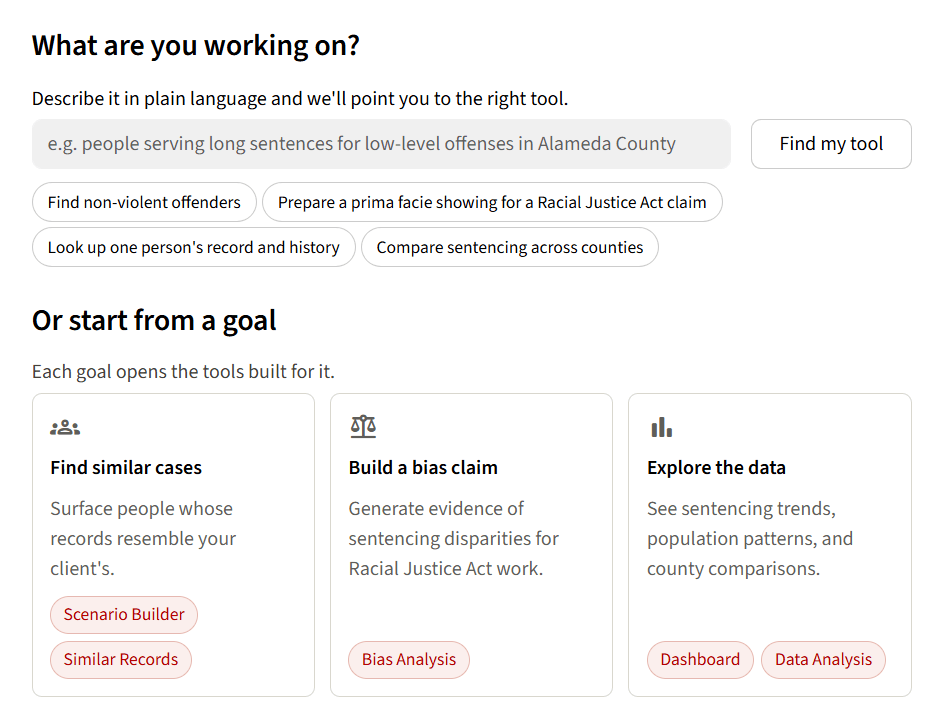
Our platform helps public defenders, prosecutors, judges, researchers, and advocates, regardless of technical background, investigate how California sentences people. It draws on a database of more than 90,000 individual prison sentences, sourced from the California Department of Corrections and Rehabilitation (CDCR) through public records requests.
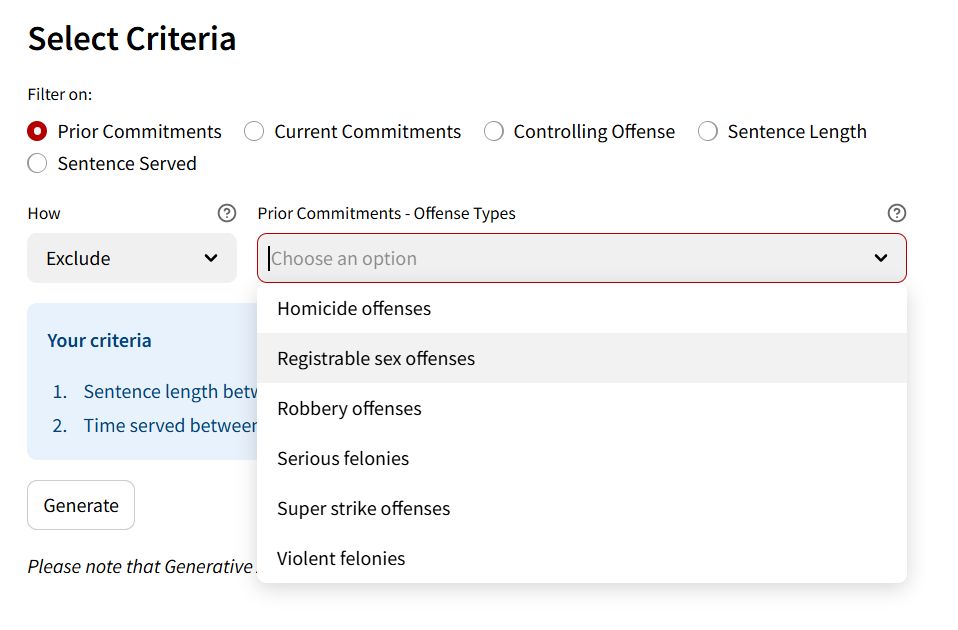
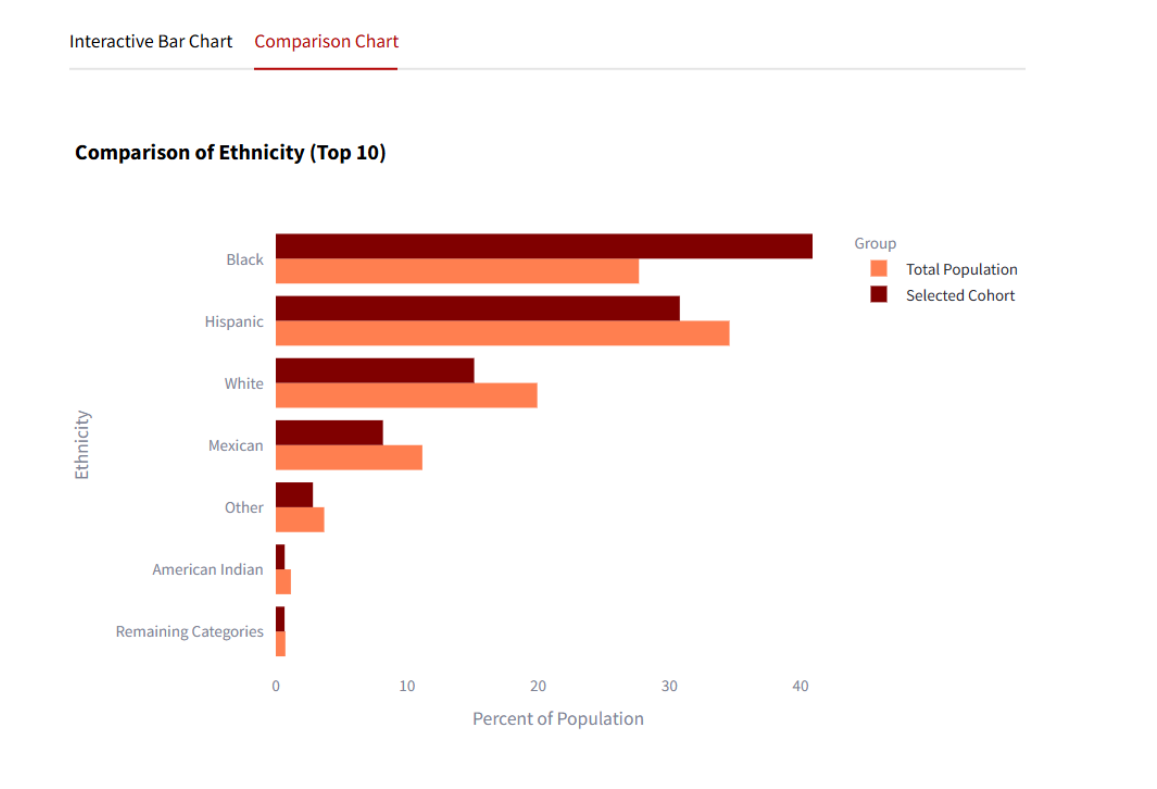
Describe who you are looking for in ordinary language, by controlling offense, prior convictions, sentence length, time served, or sentencing county, and the platform builds a matching cohort. From there you can compare outcomes across racial groups, measure disparities, and export the results as statistical evidence.
How It Works
Process:
- You ask. Pose a question the way you would describe a case to a colleague. Example: “Show me everyone sentenced for a robbery-related offense.”
- The platform interprets. A large language model identifies the relevant field (Offense Description), extracts the search terms (theft, robbery), and sets the logic that connects them (OR). It shows you what it understood before it runs, so nothing is a black box.
- It builds the cohort. Your criteria run against all sentencing records and return every matching sentence.
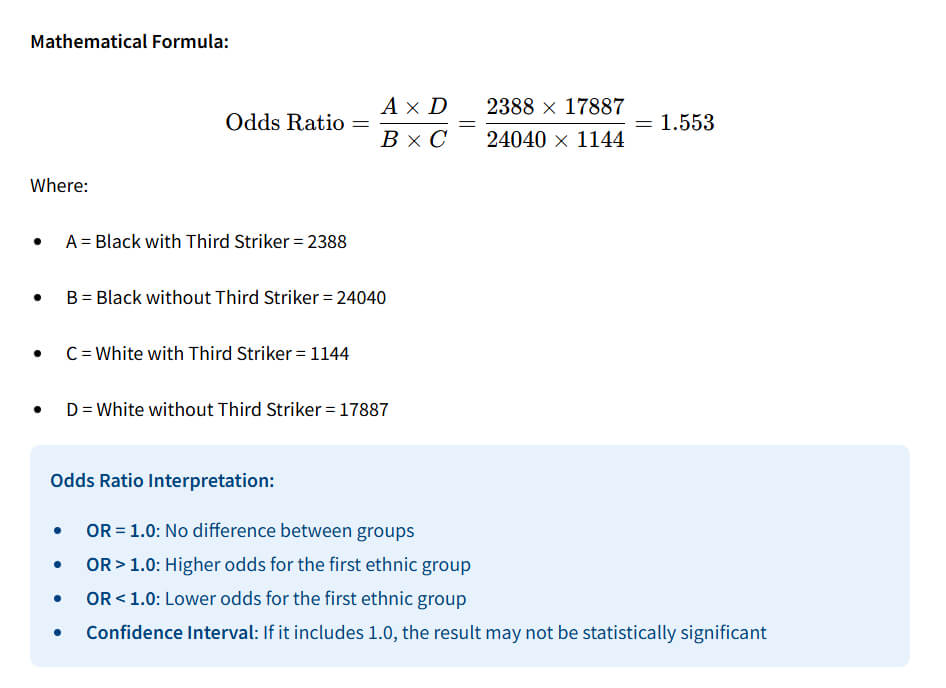
- It measures the disparity. The model breaks the cohort down by race and other attributes and quantifies the differences in sentencing outcomes using statistical techniques like odds ratios.
- You export. Carry the visualizations, cohort lists, and statistics into a motion, a petition, or a research paper.
Use Cases
Build statistical evidence for the racial justice act:
The California Racial Justice Act prohibits a sentence imposed on the basis of race, and it lets a defendant prove a violation with statistical evidence: a showing that people of their race received longer or more severe sentences than similarly situated people of other races convicted of the same offense.
We help produce analyses for prima facie showings and discovery motions (prior to an evidentiary hearing). Point the tool at an offense and it breaks the cohort down by race and surfaces the disparity. We use statistical methods such as odds ratios, relative risk, and chi-square tests, measures recognized in prior RJA cases like People v. Windom.
Because the RJA makes statistical and aggregate data admissible, and does not require statistical significance to establish a difference, an analysis like this can support the prima facie showing that triggers an evidentiary hearing. Work that once required a statistician and weeks of effort, an attorney can now generate in minutes.
find similarly situated cases:
Every disparity claim under the Racial Justice Act rests on a comparison between similarly situated people: individuals convicted of the same offense with comparable records. Assembling that comparison group by hand is slow and error-prone.
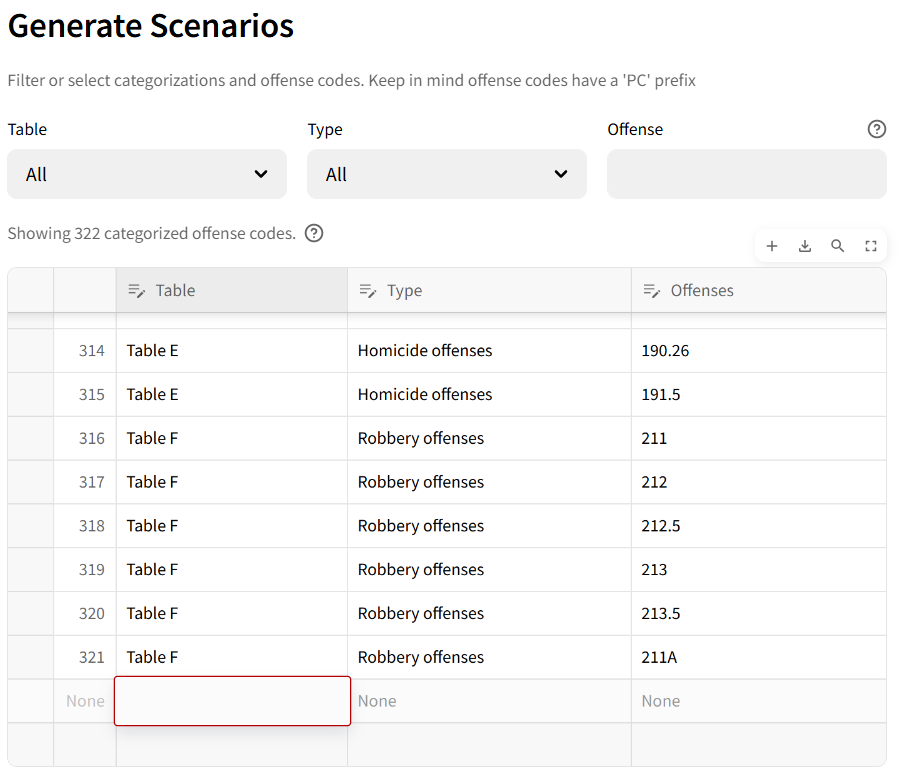
We automate this cohort building task. Sort penal codes into predefined offense types or define your own, and it groups together the individuals who share the same profile of current and prior commitments. The result is a defensible comparison cohort, the “similarly situated” population the statute requires, built in seconds rather than weeks of manual case review. The same capability surfaces candidates for second-look and resentencing review.
Tutorials & Resources
Talks, guides, and the research grounding our platform design.
Building Transparent AI Systems for Justice: From Criminal Reform to Legal Access
December 2025 | ACM FAccT
A technical talk on designing transparent and ethical AI systems for access to justice in civil and criminal landscapes.
Read More
Defenders Meet AI: Redo.io
April 2026 | UC Berkeley
A webinar on Redo.io for Racial Justice Act A4 motions hosted by UC Berkeley School of Law’s Criminal Law and Justice Center
Read More
Redo.io User Guide: An AI Powered Tool for Sentencing Data Analysis
March 2026 | RJA Blog
A step-by-step user guide to the Redo.io platform written by Madison Hill (3L) at Santa Clara University School of Law for Professor David Ball’s Racial Justice Act blog.
Read More
Can LLMs Synthesize Court-Ready Statistical Evidence? Evaluating AI-Assisted Sentencing Bias Analysis for California Racial Justice Act Claims
April 2026 | ACM CHI
An evaluation of our bias analysis tool in which human statisticians assessed the accuracy and reliability of AI-synthesized statistical evidence for RJA claims.
Read More
AI-Powered Resentencing: Bridging California’s Second-Chance Gap Through Natural Language and Vector-Based Legal Analytics
May 2025 | ICAIL
A deep-dive into our methodology for identifying similarly situated cases and surfacing candidates suitable for resentencing.
Read More
Open Code, Open Data
The full platform is not open source, but the models, algorithms, and statistical methods behind it are public on GitHub, along with evaluations of our AI integrations benchmarked against human statisticians.
The statistical engine behind our disparity analyses the same measures accepted in prior RJA cases
Vector-based methods for identifying similarly situated cases, the comparison group the RJA requires
Tutorials
If you make use of our dataset(s) or code, please cite our work as follows:
APA style:
Redo.io. AI Assistant (Version 1.0.0) [Computer software]. tool.redoio.info
BibTex:
@software{Redo_io_AI Assistant, author = {{Redo.io}}, title = {{resentencing-data-initiative}}, url = {tool.redoio.info}, version = {1.0.0}}
Citation
APA style:
Redo.io. AI Assistant (Version 2.2.0) [Computer software]. tool.redoio.info
BibTex:
@software{redoio_ai_assistant_2026,
author = {{Redo.io}},
title = {{Redo.io AI Assistant}},
url = {https://tool.redoio.info},
version = {2.2.0},
year = {2026}}